
-
 Library Home
- Chevrolet
- Camaro
- 1967 Chevrolet Camaro
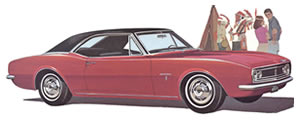 |
| Its overall appearance included a long hood and short rear deck with the popular "Coke-bottle" shape dominating the design |
1967 Chevrolet Camaro
In 1964, General Motors gave the "green light" and go-ahead for the F-car project, in response to Ford's Mustang "Pony Car." Two years later, the Chevrolet Camaro hit the ground running! From the get-go the Camaro was available in a hardtop coupe and convertible body styles, and could be ordered with nearly 80 factory options and 40 dealer accessories, including three main option packages and a choice of four different engines. The RS package included numerous cosmetic changes including a blacked out grill with hidden headlights, revised parking and tail lights, upgraded interior trim, and RS badging. The SS package included a modified 350 V8 with an available 396 big block producing 325hp and later a 375hp version, along with simulated air-intakes on the hood, special bumble bee striping, and a blacked out grill. It was also possible to order both the RS and SS packages, and receive a RS/SS Camaro. The Z-28 included mandatory front disc brakes with power assist, and the Muncie 4-speed transmission and was available to the public solely to qualify the car for racing. The Z-28's 302 V8 was one of Detroit's hottest small blocks, and was created by installing the 283's crankshaft in a 327 small block, which allowed Chevy to comply with regulations and stay within SCCA racing's 305 cubic inch limit. Rated horsepower was said to be at just 290hp, but rumored to be a lot more! The Z-28 also came with competition suspension, broad racing stripes on the hood and trunklid and could be combined with the RS option package. There wasn't any Z-28 badging as it would have attracted to much attention. The Z28 was tough to beat and boasted a 140mph top speed and numerous racing victories. Chevrolet first described the 1967 Camaro as a "road machine" and promised buyers "wide stance stability and big-car power."The Camaro was Chevrolet's delayed reaction to the 1964 Ford Mustang. It was the fourth totally new line of cars that Chevrolet had introduced since the Corvair first appeared in late 1959. While inspired by the "pony car" segment that the Mustang had carved out of the marketplace, the first Camaro was really promoted as more of a "Junior Corvette" that gave the family man with a hunkering for a real sports car the opportunity to buy one with four seats. Sport coupe and convertible body styles were available. Its overall appearance included a long hood and short rear deck with the popular "Coke-bottle" shape dominating the design. Many options and option packages were offered with some "model-options" that turned the basic Camaro into several distinct models. It had a unitized body with bolted on front frame section to carry the engine, front suspension, steering, and sheet metal components.1967 Chevrolet Camaro Production Numbers
| Model Number | Body/Style Number | Body Type & Seating | Factory Price | Shipping Weight | Total Production |
| Camaro Series 23 - Six-Cyl | |||||
| 23 | 37 | 2 Dr Coupe | $2,466 | 2,770 lbs | Note 1 |
| 23 | 67 | 2 Dr Convertible | $2,704 | 3,025 lbs | |
| Camaro Series 24 - V8 | |||||
| 24 | 37 | 2 Dr Coupe | $2,572 | 2,920 lbs | Note 1 |
| 24 | 67 | 2 Dr Convertible | $2,809 | 3,180 lbs | |
| Camaro Rally Sport Series 23 + Z22 - Six-Cyl | |||||
| 23 | 37 | 2 Dr Coupe | $2,571 | - | Note 2 |
| 23 | 67 | 2 Dr Convertible | $2,809 | - | |
| Camaro Rally Sport Series 24 + Z22 - V8 | |||||
| 24 | 37 | 2 Dr Coupe | $2,677 | - | Note 2 |
| 24 | 67 | 2 Dr Convertible | $2,914 | - | |
| Camaro SS Sereis 24 + Z27 - RPO L48 - Turbo Fire 350 V8 | |||||
| 24 | 37 | 2 Dr Coupe | $2,783 | - | Note 3 |
| 24 | 67 | 2 Dr Convertible | $3,019 | - | |
| Camaro SS Sereis 24 + Z27 - RPO L35 Turbo-Jet V8 | |||||
| 24 | 37 | 2 Dr Coupe | $2,835 | - | Note 3 |
| 24 | 67 | 2 Dr Convertible | $3,072 | - | |
| Camaro SS Sereis 24 + Z27 - RPO L78 Tirbp Ket 396 V8 | |||||
| 24 | 37 | 2 Dr Coupe | $3,072 | - | Note 3 |
| 24 | 67 | 2 Dr Convertible | $3,309 | - | |
| Camaro Z/28 Sereis 24 + Z/28 - V8 | |||||
| 24 | 37 | 2 Dr Coupe | $3,273 | 3,520 lbs | 602 |
| Notes: |
| A total of 220,906 Camaros were produced including 160,648 base Coupes and 25,141 base Convertibles. A total of 64,842 Camaros had the Rally Sport (RS) option. A total of 34,411 Camaros had the Super Sport (SS) option. |
Chassis Data
| Model | Wheelbase | Overall Length | Width | Front Tread | Rear Tread | Tires |
| Camaro | 108.1 in | 164.6 in | - | 59 in | 58.9 in | 7.35 x 14 |
| Camaro SS 350 | 119 in | 213.2 in | - | 62.5 in | 62.4 in | D70 x 14 |
| Camaro Z/28 | 119 in | 212.4 in | - | 63.5 in | 63.4 in | 7.75 x 15 |
1967 Chevrolet Camaro Gallery
Related Reading
Like this article? You might also enjoy these related articles.


OldRide Marketplace
Check out Chevrolet items for sale in the OldRide Marketplace.

1933 Chevrolet Roadster
$37,500

1957 Chevrolet 210
$35,995

1964 Chevrolet El Camino
$31,495
2016 Chevrolet Corvette
$54,900

1972 Chevrolet El Camino
$40,995
Recent Articles
Like this article? You might also enjoy these related articles.


