
-
 Library Home
- Chevrolet
- Corvette
- 1963 Chevrolet Corvette
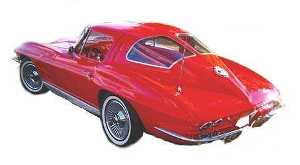 |
| The famous split window Corvette was first offered in 1963 |
1963 Chevrolet Corvette
Aerodynamic design, a fastback coupe, new passenger comfort and new independent suspension both front and rear. These were just a few of the exciting new features found in the 1963 Corvette. What a package Chevrolet's styling and engineering divisions had to offer in the 1963 Corvette! Everything was changed and there was nothing left over from the 1962 model, let alone the 1953 model. Starting at the bottom and working up, the frame was mostly box-section with side rails spread wide to the extreme width of the body between the wheels for lower floor pans and increased passenger protection from side blows. Five cross-members tied the side rails together into a rigid unit. The front cross-member was an integral part of the frame assembly instead of a bolt-on portion used on previous Corvettes. This front member was a husky stamping designed to anchor all front suspension components and at the same time dip low enough to give ample engine clearance. The front suspension, although not revolutionary in design, was all-new for the Corvette. Unequal length A-arms, coil springs and spindle assembly were quite similar to that used on the 1963 Chevy passenger cars and in fact, many parts were interchangeable between the two cars, This use of standard Chevy parts gave the 1963 Corvette ball joint suspension at both top and bottom pivot points on the spindle. The coils springs angled inward sharply from their pad in the lower control arm to the upper seat in the frame rail. A radical departure from previous years was employed in the 1963 Corvette rear suspension. It's fully independent, first time ever used in a late model American production automobile. Chevy called it a three-link independent suspension. The differential unit brackets directly to the frame with one point at the lower front and two points at the upper rear of the housing. Rubber insulators isolate running gear noise from the passengers.1963 Chevrolet Corvette Production Numbers
| Model Number | Body/Style Number | Body Type & Seating | Factory Price | Shipping Weight | Total Production |
| Corvette | |||||
| 08 | 37 | 2 Dr Fastback Coupe | $4,257 | 3,150 lbs | 10,594 |
| 08 | 67 | 2 Dr Convertible | $4,037 | 2,881 lbs | 10,919 |
Chassis Data
| Model | Wheelbase | Overall Lenght | Width | Front Tread | Rear Tread | Tires |
| Corvette | 98 in | 175.3 in | 69.6 in | 56.3 in | 57 in | 6.70 x 15 |
1963 Chevrolet Corvette Options
| Code | Description | Price |
| 898* | Genuine Leather Seats | $80.70 |
| 941 | Sebring Silver Exterior Paint | $80.70 |
| A01 | Soft-Ray Tinted Windows (all glass) | $16.15 |
| A02 | Soft-Ray Tinted Windshield | $10.80 |
| A31 | Power Windows | $59.20 |
| C07 | Auxiliary Hardtop | $236.75 |
| C48 | Heater & Defroster Deletion (credit) | $100.00 |
| C60 | Air Conditioning | $421.80 |
| G80 | Positraction Rear Axle | $43.05 |
| G91 | Special Highway Axle 3.08:1 Ratio | $2.20 |
| J50 | Power Brakes | $43.05 |
| J65 | Sintered Metallic Brakes | $37.70 |
| L75 | 327-cid/300-hp V8 | $53.80 |
| L76 | 327-cid/340-hp V8 | $107.60 |
| L84 | 327-cid/360-hp V8 | $430.40 |
| M20 | 4-Speed Manual Transmission | $188.30 |
| M35 | Powerglide Automatic Transmission | $199.10 |
| N03 | 36-Gallon Fuel Tank | $202.30 |
| N11 | Off Road Exhaust System | $37.70 |
| N34 | Wood-Grained Plastic Steering Wheel | $16.15 |
| N40 | Power Steering | $75.35 |
| P48* | Cast Aluminum Knock-Off Wheels | $322.80 |
| P91 | 6.70 x 15 Nylon Black Sidewall Tires | $15.70 |
| P92 | 6.70 x 15 Rayon White Sidewall Tires | $31.55 |
| T86 | Back-Up Lights | $10.80 |
| U65 | Signal Seeking AM Radio | $137.75 |
| U69 | AM-FM Radio | $174.35 |
| Z06* | Special Performance Equipment | $1,818.45 |
1963 Chevrolet Corvette Engine Options
Location Of Engine Code: Stamped on the block in front of the right hand cylinder head.| Letter Code | Engine | Horsepower | Torque | Transmission | Carburetor |
| RC | 8-327 | 250 | 350 | 3 & 4-Speed Manual | 4 BC |
| RD | 8-327 * | 300 | 360 | 3 & 4-Speed Manual | 4 BC |
| RE | 8-327 + # | 340 | 344 | 3 & 4-Speed Manual | 4 BC |
| RF | 8-327 + | 360 | 352 | 3 & 4-Speed Manual | Fuel Injection |
| SC | 8-327 | 250 | 350 | Powerglide | 4 BC |
| SD | 8-327 * | 300 | 360 | Powerglide | 4 BC |
Transmission Codes
| Transmission | Location |
| 3-Speed Manual | Stamped on rear face of upper right corner |
| 4-Speed Manual | Stamped on cover side rear flange (Warner), stamped on cover side of case (Muncie). |
| Powerglide | Stamped on the bottom of oil pan |
| Plant and Type Designation Prefix | Plant | Transmission Type |
| W | Warner Gear | 3-Speed |
| S | Saginaw | 3-Speed |
| M | Muncie | 3-Speed, Overdrive* |
| C | Cleveland | Powerglide |
| T | Toledo | Powerglide |
| D | Saginaw | Overdrive |
| K | McKinnon | 3-Speed |
| E | McKinnon | Powerglide |
| O | Saginaw | Overdrive |
| A | Cleveland | 2-Speed, Manual Powerglide |
1963 Chevrolet Corvette Exterior Paint Codes
| Color Name / Code | Color Image | Color Name / Code | Color Image |
| 900 - Tuxedo Black Lucite® Code - 88 Dulux® Code - 93-005 |  |
938 - Adobe Beige Lucite® Code - 4256L Dulux® Code - 93-95186 |  |
| 920 - Fawn Beige Metallic Lucite® Code - 4257L Dulux® Code - 181-95187 |  |
940 - Sateen Silver Metallic Lucite® Code - 4247L Dulux® Code - 181-95176 |  |
| 923 - Roman Red Lucite® Code - 2931LH Dulux® Code - 93-93037H |  |
948 - Honduras Maroon Metallic Lucite® Code - 4389LM |  |
| 936 - Ermine White Lucite® Code - 4024L Dulux® Code - 93-93774 |  |
||
NOTES: General Motors paint code plate for all models except Corvair and Corvette is located under the hood at the top of the firewall on the left or right of the upper shroud. Corvair paint code plate is on the left rear wheel housing. Corvette paint code plate is under the dash, below the glove compartment. |
|||
1963 Chevrolet Corvette Interior Paint Codes
| Color Name / Code | Color Image | Color Name / Code | Color Image |
| Ivory Lucite® Code - (semi-gloss) | |
Dark Green Metallic Lucite® Code - (semi-gloss) Lucite® Code - (flat) |  |
| Medium Fawn Metallic Lucite® Code - (semi-gloss) | |
Medium Aqua Metallic Lucite® Code - (semi-gloss) |  |
| Dark Fawn Metallic Lucite® Code - (semi-gloss) Lucite® Code - (flat) |  |
Dark Aqua Metallic Lucite® Code - (semi-gloss) Lucite® Code - (flat) |  |
| Medium Saddle Metallic Lucite® Code - (semi-gloss) Lucite® Code - (flat) |  |
Light Red Lucite® Code - (flat) | |
| Medium Saddle Lucite® Code - (flat) | |
Medium Red Lucite® Code - (semi-gloss) |  |
| Medium Blue Metallic Lucite® Code - (semi-gloss) Lucite® Code - (flat) |  |
Medium Red Metallic Lucite® Code - (flat) | |
| Dark Blue Metallic Lucite® Code - (semi-gloss) Lucite® Code - (flat) |  |
Black Lucite® Code - (flat) |  |
| Medium Green Metallic Lucite® Code - (semi-gloss) |  |
||
| NOTE: Unrubbed LUCITE® will generally produce a gloss comparable to original unrubbed interior semi-gloss finishes. If lower gloss is required, use DuPont #4528 flattening compound to reduce gloss. | |||
| Trunk Colors (spatter finish) |
| Gray 389-195 |
Axle Codes
Location Of Axle Codes: The axles for Chevrolet will be built by Chevrolet Buffalo, Chevrolet Gear and Axle, Buick, Oldsmobile, and McKinnon. Divisional Manufacturer code letters will be metal stamped on the axle tube adjacent to the carrier for identification. Metal stamp on left rear axle tube on the rear side, letters and numerals 3/16 in. high, 3 in. outboard of carrier.| Codes - Non-Locking | Codes - Locking | Ratio | Inspection Cover |
| CZ | CJ | 3.08 | 10 Bolt |
| CA | CB | 3.36 | 10 Bolt |
| CC | 3.55 | 12 Bolt | |
| CX | CD | 3.70 | 12 Bolt |
| CE | 4.11 | 12 Bolt | |
| CF | 4.56 | 12 Bolt |
Related Reading
Like this article? You might also enjoy these related articles.


OldRide Marketplace
Check out Chevrolet items for sale in the OldRide Marketplace.

1973 Chevrolet Corvette
$32,900

1957 Chevrolet Bel Air
$62,995

1985 Chevrolet Corvette
$9,995

1964 Chevrolet Impala
$51,995

2021 Chevrolet Other
$134,895
Recent Articles
Like this article? You might also enjoy these related articles.


